September is Suicide Prevention Awareness Month and I don’t want to let this month go by without taking the time to address this issue, specifically as it relates to the church and Christian families.
I think that, too often, we can be afraid to address this issue in the church. It’s almost like there’s an unspoken belief that Christians shouldn’t struggle with their mental health and that, when they do, it must mean they don’t have enough faith or aren’t trusting God like they “should.”
This unspoken belief can cause so much harm. And it’s simply not true.
The truth is, anyone can struggle with challenges connected to mental health. ANYONE.
And, the truth is, talking about it can provide a safe place where those who struggle feel supported, heard, and understood . . . where those who struggle can recognize that they are not alone and that their struggle does not mean they are not trusting God enough.
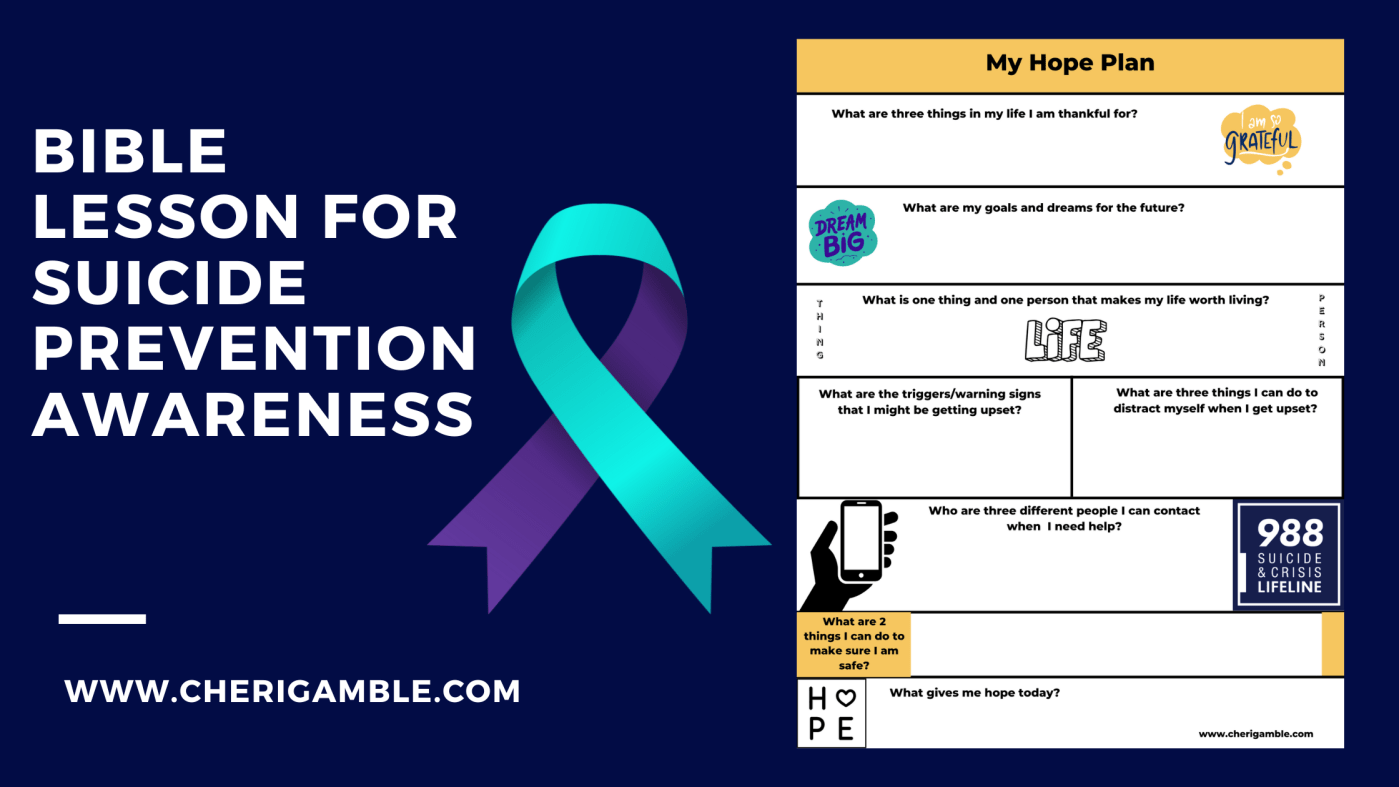
Today I want to provide a free Bible lesson outline to help you start the discussion with your family or church group as well as a hope plan to help your group think through what gives them hope and to identify who they can talk to when they struggle – and when they should reach out. You can print off both below, or scroll down to see the whole plan right here on this site.
The symbol of Suicide Prevention Awareness Month is a semicolon. The semicolon (;) serves as a reminder that, when the story could have ended, the author made a decision to keep it going.
Let’s help others keep their stories going, too. Begin the conversation.
Bible Lesson Outline based on 1 Kings 19
Begin by sharing some statistics connected to Suicide Prevention Awareness Month. You could do this as a quiz, discussion, or simply share the statistics. The following statistics are from the NAMI website:
- 1 in 20 U.S. adults (5%) have serious thoughts of suicide each year.
- About 1 person dies by suicide in the U.S. every 11 minutes.
- 79% of all people who die by suicide in the U.S. are male.
- Although more women than men attempt suicide, men are 4x more likely to die by
suicide. - In the U.S., suicide is the 2nd leading cause of death among people ages 10-14 and among people ages 15-24, and the 11th leading cause of death overall.
Use some of the following questions to aid in your discussion:
- What stands out to you the most about these statistics?
- What do you think is the reason suicide is the 2nd leading cause of death among those 10-14 and 15-24?
- What kind of things do you think lead a person to consider suicide?
- Do you think these statistics hold true for those who are Christians as well as those who are not? Discuss.
Say: The truth is, suicide can impact anyone – including those who believe in and follow Jesus. We never know what is going on in someone’s mind or how they are feeling. You might know someone who has thought about or died by suicide. You yourself might have thought about it before, too. Let’s spend some time talking about this issue – starting with someone from the Bible who also struggled with the desire to die when life felt overwhelming to him.
Ask: Anyone have an idea who I’m talking about? (Allow students to answer) I’m talking about the prophet Elijah. What do you know about Elijah? (Allow students to answer, being sure to bring about the famous story from 1 Kings 18 when Elijah took on the prophets of Baal.)
Read 1 Kings 19. (Depending on your group and your teaching style, you might choose to have different students read sections, or you might read the whole thing from a version that is easy to understand such as the NLT. For younger students or more active groups, you might want to tell the story in your own words or have volunteers act it out as you read. If you decide to have students act it out as you read, you could have students take on the parts of Elijah, the angel, the tree, and the Lord. You could then have all the students act out the windstorm and earthquake when you get to that part.)
Questions for discussion:
- How was Elijah feeling during this chapter?
- Why do you think he was feeling that way? (Notice: He had just completed an amazing time on the mountaintop where he saw God move in an incredible way. Sometimes our lowest times can come right after those feel-good, mountaintop experiences.)
- What did the angel of the Lord tell Elijah to do? Why do you think that was important?
Note: After Elijah rested and ate, he travelled 40 more days and nights to Mount Sinai. AND HE WAS STILL FEELING DOWN WHEN HE GOT THERE!! Sometimes our challenging emotions last awhile. And sometimes we need help getting through them.
- What did the Lord say to Elijah when he got to Mount Sinai?
Look what happened here! Do you think the Lord needed to know what was going on with Elijah? No, He already knew! But He gave Elijah the opportunity to talk . . . and He listened and then He appeared to Him in a whisper! He was gentle with Elijah. Compassionate. He cared.
And then He put a plan in place to help Elijah.
- What did the Lord tell Elijah to do? What do you think is significant about this?
The Lord sent Elijah to get support! He reminded Elijah that he wasn’t alone, there were 7,000 people on his side! And then He gave Elijah a helper, a friend, a co-worker, someone who would support Elijah and take some of the weight off of Elijah’s shoulders. Who was this helper? That’s right, Elisha.
So, what can we learn about this story that might be helpful for us when we are struggling?
- Make sure to take care of your physical needs. Proper nutrition and proper rest are SO important. We might not feel like eating, but it is so important to get the nutrients we need, especially when we are struggling with challenging emotions.
- Be honest about how you are feeling. Notice that when God asked Elijah what was going on, he was honest. He didn’t try to hide the fact that he was struggling. And notice that God let him talk without judgment. God was compassionate and God listened – more than once. (Sidenote: There’s an amazing children’s picture book called “The Rabbit Listened” that you might choose to read or reference at this time. It can serve as a reminder of the importance of listening to those who are struggling.)
- Reach out for and accept support. We were made to live in relationships, to support one another, to be a community. When we are experiencing challenging emotions, a lot of times all we want to do is isolate. We feel all alone and we end up doing things that make us feel even more alone. However, we are NOT all alone. Look around you. Everyone in this room is part of your community. We want to support you – we need to support each other.
Ask: What are some things we can do as a community to better support those who are hurting? Discuss.
Take this time to remind students that another person’s cry for help should never be kept confidential. Tell them that if someone comes to them saying they are thinking of suicide, the best thing they can do for them is go with them to talk to someone who can help – a parent, a school counselor, a teacher, their youth leader, any safe adult. (The same holds true for you. If one of your students comes to you with suicidal thoughts, this is NOT something to keep confidential. Be the adult who takes them seriously and helps them get the help they need.)
Give out copies of the Hope Plan. Say: This is a Hope Plan . . . a plan that can help you think of what gives you hope, what it looks like when you start to lose hope, and who you can contact when you need support. Let’s take some time to fill it out right now.
Give students a chance to fill it out, answering any questions that might come up. Then encourage them to keep it in a special place and to refer to it when they start to feel challenging emotions. You might also choose to give them time to discuss their answers in small groups.
Close the session by sharing the story of the semicolon (see above) and reminding each student that they are important and their lives matter. Say: Do you know what happened with Elijah? He kept his story going and what a story he had! At the end, God took him away in a chariot of fire (you can read about it in 2 Kings 2).
Keep your story going, too! You matter!
End the lesson by praying for one another.
By the way, you matter, too,
Cheri


 Cheri Gamble
Leave a comment